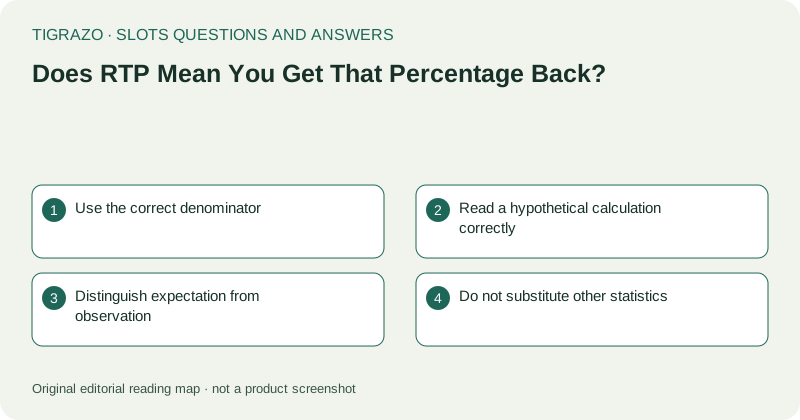
Use the correct denominator
The denominator in RTP is total stakes wagered, not simply money deposited. Funds can be wagered, partly returned as awards, and wagered again. As a result, wager volume can exceed the initial amount available in an account.
A person depositing 20 units does not have a guaranteed return determined by multiplying that deposit by the published percentage. The statistic concerns the game's mathematical expectation across wager volume under the relevant configuration.
Read a hypothetical calculation correctly
Suppose a hypothetical game has 96% RTP. Across 1,000 units of total wagers, the expected return is 960 units and the expected loss is 40 units. These are expectation calculations, not a prediction that a particular sequence will produce those exact amounts.
One session could end with no remaining balance, another with a substantial award, and many with other results. The distribution of outcomes matters, and RTP alone does not describe its full spread or the timing of awards.
Distinguish expectation from observation
An observed return percentage can be calculated for a recorded sample, but it is not automatically the underlying RTP. Short samples can be far from the theoretical expectation, especially when rare awards contribute materially to the model.
For a hypothetical sample with 100 units wagered and 70 units awarded, the observed return is 70%. That does not prove the configured RTP is 70%. It describes only the amounts in that sample, assuming the record is complete and the units match.
Do not substitute other statistics
- Hit frequency concerns how often a defined award event occurs.
- Volatility concerns variation in outcomes.
- A maximum award describes a ceiling under stated conditions.
- RTP describes long-run expected return over wagers.
A game can have frequent awards smaller than the stake. It can also include rare large awards that affect RTP without being likely to appear in one session. None of these facts creates a personal repayment schedule.
Check which configuration the figure describes
Some titles can exist with different RTP settings. Read the information for the actual version being considered rather than assuming a figure from another presentation applies. If the configuration is not identified, mark the number uncertain.
Most importantly, do not continue playing to bring a session back toward the stated RTP. There is no requirement for your balance to converge to that percentage within a usable time. Spending boundaries should reflect the possibility of loss, not an expectation that a theoretical average will repair a disappointing session.