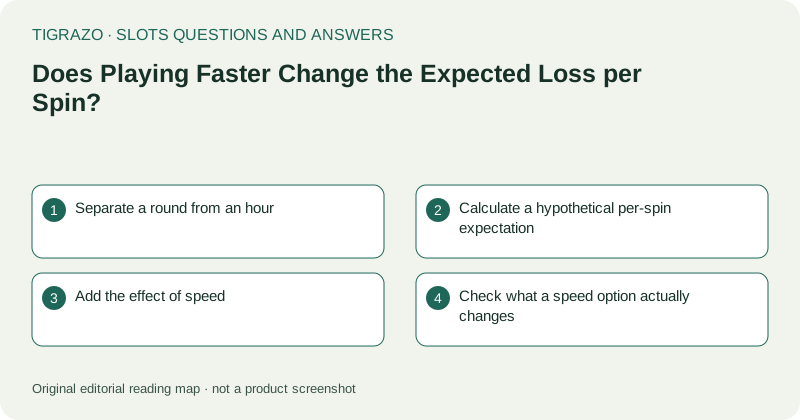
Separate a round from an hour
Expected loss per spin depends on the stake and the expected return under the relevant rules. Expected loss over time also depends on how many paid spins occur. Confusing these units can make a speed setting appear mathematically harmless when it still changes financial exposure.
Actual outcomes can differ greatly from expectation. A faster session is not guaranteed to lose a particular amount, but a lower animation delay does not create better odds by itself.
Calculate a hypothetical per-spin expectation
Suppose a hypothetical game has 96% RTP and a total stake of 0.50 units per paid spin. The expected return per spin is 0.48 units, and the expected loss is 0.02 units. This calculation assumes the stated configuration and includes the relevant awards in its mathematical model.
It does not say that each spin loses exactly 0.02 units. Individual results may return nothing, return less than the stake, or pay more. Expectation summarises the weighted outcomes.
Add the effect of speed
At one hundred paid spins in a hypothetical hour, total wagers would be 50 units and expected loss would be 2 units. At two hundred paid spins under the same conditions, wagers would be 100 units and expected loss would be 4 units.
The per-spin expectation remains 0.02 units in both cases. The difference comes entirely from the number of paid rounds. These illustrative rates are not estimates of any actual game's pace or a forecast of a real session.
Check what a speed option actually changes
- Does it shorten animation only?
- Does it initiate additional paid rounds automatically?
- Does it alter the stake or another setting?
- Do feature sequences affect the number of paid rounds possible?
- Can you still read the result and stop comfortably?
If another rule changes alongside speed, analyse that change separately. Do not assume a control's name fully explains its effect, and do not mistake free feature spins for additional paid stakes when calculating wager volume.
Use time and spending boundaries together
A time limit alone can permit very different wager volumes at different speeds. A spending boundary adds a separate constraint, while a slower pace may leave more room to notice decisions and understand results. Neither creates a winning method.
The direct answer is therefore about units: faster play does not inherently increase expected loss per unchanged spin, but it can increase expected loss per hour by increasing paid play. That distinction matters even when the selected stake never moves.