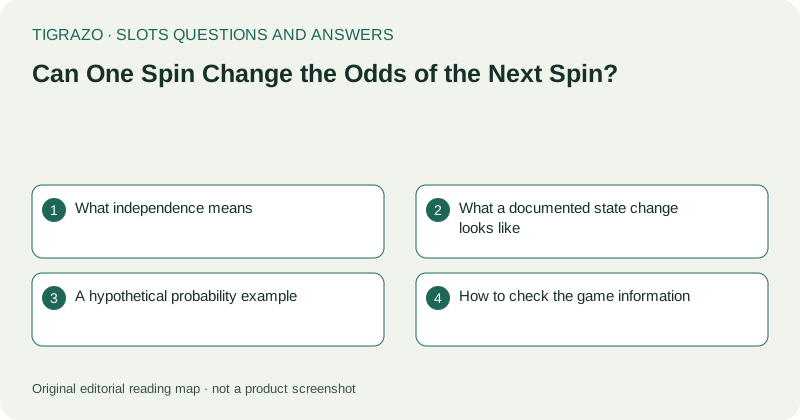
What independence means
Independence means that knowing a previous outcome does not change the probability of the next event under the same conditions. A string of losses, a recent large award, and an apparent near miss are all part of the history. They do not by themselves tell you that the next spin has become more or less favourable.
This is a statement about the relationship between events, not a claim that every game has identical rules. Always distinguish independent base play from an explicitly changing feature state.
What a documented state change looks like
A game may describe a persistent counter, a held symbol, a changing multiplier, or a feature stage that carries information forward. In such a case, the relevant conditions are not unchanged. The rules should explain what persists and what effect it has.
Do not infer such a mechanism from an animation alone. A decorative meter or an almost-completed combination does not establish that probability has changed. The important evidence is the stated rule governing the next round.
A hypothetical probability example
Suppose a simplified independent process has a 20% chance of a defined event on each trial. After five unsuccessful trials, the next-trial chance is still 20%, assuming nothing else changes. After one successful trial, it is also still 20%.
This hypothetical process is not an estimate for a slot. It illustrates why neither a losing run nor a recent success supplies timing information. The defined event could also differ from a profitable round, so its meaning must be clear.
How to check the game information
- Identify whether the current round is base play or part of a feature.
- Read any rule about persistent progress or held elements.
- Check whether changing a setting creates a different configuration.
- Keep documented effects separate from impressions about streaks.
If the rules are unclear, do not use paid play to test a theory. A short sequence cannot establish the underlying probability structure reliably, and an apparent pattern may arise by chance.
What this means for stopping
A previous result is not a reason to extend a session beyond a limit. Neither being behind nor feeling close creates an entitlement to a favourable next spin. Likewise, a recent win does not prove that a productive period has started.
The useful conclusion is conditional and precise: under independent, unchanged conditions, one spin does not alter the next spin's odds. Where rules describe a changing state, analyse that state directly rather than replacing it with a general story about luck.