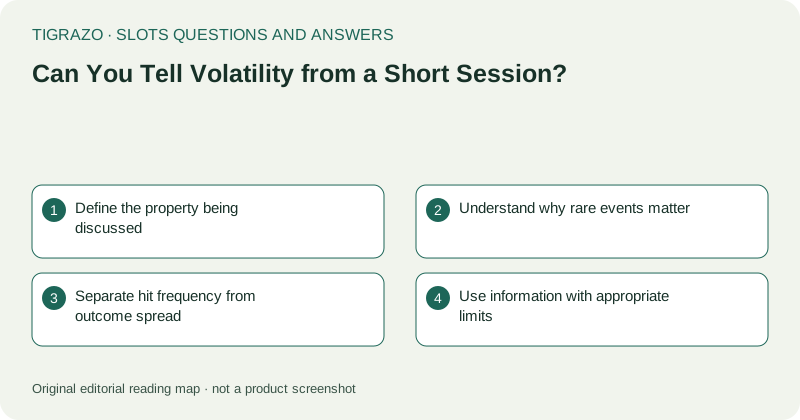
Define the property being discussed
Volatility describes variation in outcomes, including how awards are distributed between ordinary and rarer results. It is not simply a count of losing spins. Descriptive labels such as low or high can be useful summaries, but their exact meaning may vary unless a standard or numerical definition is supplied.
A short session is a sample from that distribution. It is not the distribution itself, and unusual samples can occur without contradicting the underlying model.
Understand why rare events matter
If rare large awards play an important role in a game's mathematics, a small sample may miss them completely. Another small sample may happen to include one early. The two experiences can feel like different games even when the configuration is identical.
In a hypothetical example, two people each observe one hundred rounds. One sees a large award and the other does not. Their difference demonstrates variation in those samples; it does not, by itself, establish two different volatility levels.
Separate hit frequency from outcome spread
Hit frequency measures how often a defined event occurs, often any paying result. An award below the stake can count as a hit while the round still produces a net loss. Volatility also involves award sizes and their distribution.
A game with many small awards is therefore not automatically low volatility. The rest of its outcome structure matters. Likewise, a brief dry spell does not demonstrate that every award must be unusually large when it arrives.
Use information with appropriate limits
- Look for a clearly identified volatility description.
- Check whether the description explains its scale.
- Confirm the relevant version or configuration where possible.
- Treat session impressions as observations, not measurements of the whole model.
RTP cannot fill every gap. It gives a long-run expected return relative to wagers, but two distributions can have the same expectation and very different variation. A maximum prize also does not reveal how frequently meaningful awards occur.
Record experience without overgeneralising
A precise note might say that the observed session contained long gaps between awards. It should not automatically say that the game always behaves that way or that a large return is now due. Personal comfort with the experience is another separate question.
You do not need a mathematical classification to decide that an experience feels uncomfortable. Stop according to your limits rather than extending a sample to prove a label. If reliable distribution information is unavailable, uncertainty is the correct conclusion; further spending does not guarantee that the missing picture will become clear.