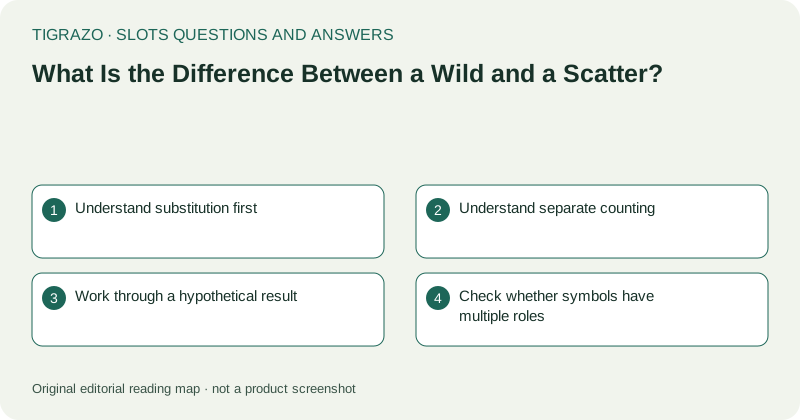
Understand substitution first
A wild can help complete an ordinary qualifying combination by standing in for an allowed symbol. It does not necessarily replace every symbol. Scatters, collectors, jackpot markers, and other special roles are often treated separately, depending on the rules.
Some wilds have extra properties, such as a multiplier, expansion, or persistence within a feature. These properties need their own explanation. The word wild alone does not tell you which additional effects exist.
Understand separate counting
A scatter often qualifies by appearing a specified number of times within an allowed area. It may not need to follow an ordinary payline, but the permitted positions and required quantity still matter. A scatter can trigger a feature, pay an award, or do both under distinct conditions.
Do not assume three is always the required quantity. Do not assume every reel can contain a qualifying scatter. A familiar icon or name cannot replace the actual trigger rule.
Work through a hypothetical result
Imagine a hypothetical line game in which three matching ordinary symbols pay, and wilds can replace those ordinary symbols. Two matching symbols plus one qualifying wild on the required line could complete the combination. If scatters are excluded from substitution, that same wild would not become a missing scatter for a feature trigger.
Suppose the hypothetical feature instead requires three scatters anywhere in a permitted area. Two scatters and a wild would not qualify under those stated exclusions. The example demonstrates role separation, not a rule for any particular game.
Check whether symbols have multiple roles
- Can a wild pay its own combination?
- Does a wild multiplier apply to every qualifying award or only specified ones?
- Does a scatter pay independently of triggering a feature?
- Can symbol behaviour change inside a feature?
- Are substitutions or multipliers capped?
A symbol can perform several functions, but each function should be supported by a rule. Combining familiar meanings from different games can produce a confident but incorrect interpretation.
Keep the distinction in plain language
A useful notebook sentence is that the wild helps eligible combinations, while the scatter follows its own counting or trigger conditions. Then add the actual exclusions and quantities for the game being read. This is more reliable than memorising a symbol's appearance.
If a result remains confusing, return to the symbol definitions and recorded round information. You do not need to keep playing to learn whether a wild will eventually act as a scatter. The answer should come from documented behaviour, not from waiting for a favourable arrangement.