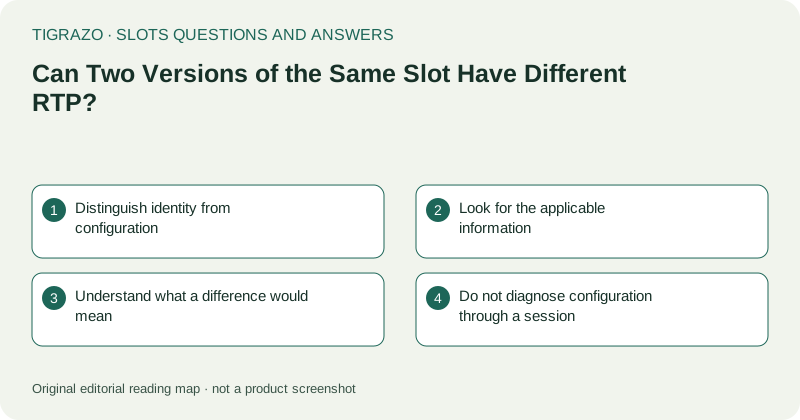
Distinguish identity from configuration
A title identifies a game presentation, but it may not identify every mathematical setting used in every environment. A provider can make several configurations available, and a deployment can use one of them. This general possibility does not prove that any particular pair of versions differs.
Visual similarity therefore supports only a limited conclusion: the presentations look alike. It cannot replace current configuration information when a numerical comparison depends on RTP.
Look for the applicable information
Read the current game's help, information, or rules panel. Note any displayed RTP and identifying details available. If an external description lists several possible values, do not automatically choose the highest one or assume it applies everywhere.
Where a figure cannot be tied to the current version, record the uncertainty. A precise note saying configuration not confirmed is more useful than a confident number borrowed from a differently identified presentation.
Understand what a difference would mean
In a hypothetical comparison, one configuration has 96% RTP and another has 94%. Across 1,000 units of wager volume, their expected returns would be 960 and 940 units respectively, with expected losses of 40 and 60 units. These are model expectations, not promised session results.
The difference does not tell you which version will pay more during any particular short run. Nor does it fully describe volatility, award frequency, or the probability of a maximum prize.
Do not diagnose configuration through a session
A disappointing sequence does not prove a lower RTP setting, and a large award does not prove a higher one. Outcome variation can overwhelm small expected differences in finite samples. Casual observation is therefore a poor substitute for documented configuration.
- Do not infer RTP from a brief demo.
- Do not copy a percentage solely because the title matches.
- Do not treat a maximum-prize label as an RTP indicator.
- Do not spend money attempting to identify a hidden setting.
Make comparisons with explicit limits
When writing notes, include the source context of the displayed figure in ordinary language: current information panel, version identified if available, and date read. If two figures are compared, ensure they refer to the same concept and appropriate configurations.
The direct answer is yes, different configurations are possible. The disciplined next step is verification, not suspicion or assumption. If the current value is unavailable, leave the comparison incomplete rather than claiming either equivalence or difference from appearance, popularity, or recent results.